How to change careers at 40
TL;DR: At 40, a career change doesn’t have to create huge chaos in your life. You can make the switch with a practical plan that doesn’t destabilize your finances or lifestyle.
Start by choosing a tech path that makes sense for your strengths and testing it before you commit. Then you can dive into learning the minimum you need to get started and building experience before you feel “ready.”
Your roadmap also keeps one eye on the practical stuff – money, energy, and time – so that transition feels exciting, not reckless.
Thinking about a career change at 40 can feel exciting and a little overwhelming. You want work that fits your life better, and maybe tech seems like the right move. But you already have a lot on your plate. You’re juggling kids, a mortgage, a full calendar, and not a ton of extra energy leftover.
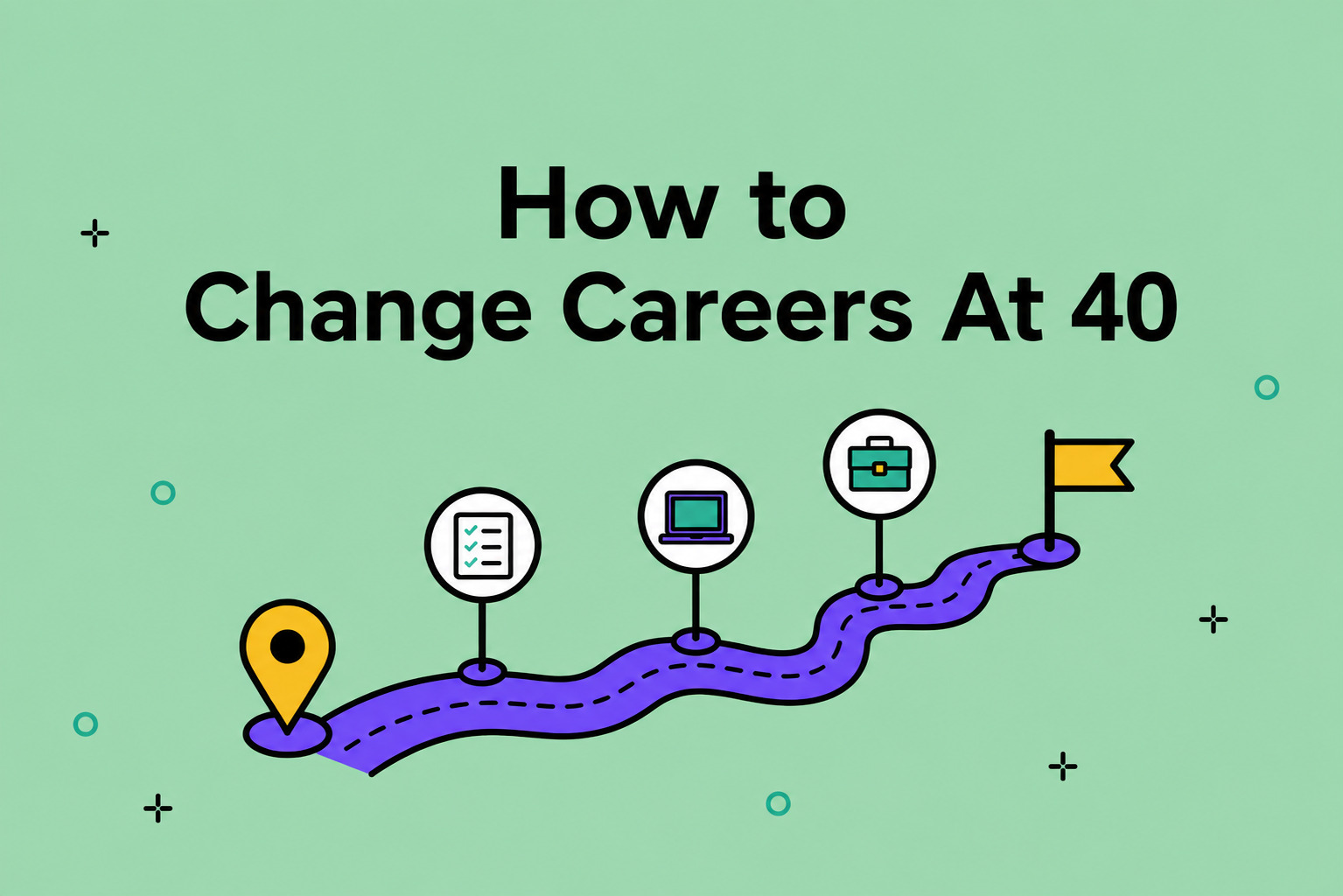
You need a practical roadmap that can help you transition careers without messing up your finances or daily life. This guide walks you through a practical, step-by-step plan to make a career change at 40.
Table of Contents
- Choose the Right Tech Path
- Map Your Transferable Skills to Tech Roles
- Validate the Role Before You Commit
- Learn What Matters Most
- Get Experience Before You’re Ready
- Network Into the Industry
- Manage Risk During Transition
- A 7-Day Tech Pivot Kickstart Plan
- Key Takeaways

Is Tech Right For you? Take Our 3-Minute Quiz!
You Will Learn:
☑️ If a career in tech is right for you
☑️ What tech careers fit your strengths
☑️ What skills you need to reach your goals

Choose the Right Tech Path
Not every tech job requires you to learn to code. Before you sign up for anything, get specific about the role you actually want to target.
There are quite a few non-coding entry points worth exploring, like:
- UX writing.
- Project management.
- Quality assurance (QA).
- Customer support.
- Tech sales.
Then if you’re more interested in the technical side, you might look at roles like:
- Front-end development.
- Data analytics.
- UX/UI design.
The most effective path is the one that fits both your existing skills and your timeline. If you already have experience writing, organizing projects, solving problems, or working with people, start there. Make a realistic plan about how quickly you need to start earning, plus what kind of income you’re aiming for.
For example, a content writer might target UX writing or content design instead of full-stack development. That path still builds on what they already know, while giving them a faster, more realistic way into tech.
If you’re wondering whether this kind of shift is realistic at your age, it absolutely is. Skillcrush’s career change resources for any age can help you start narrowing things down.
Map Your Transferable Skills to Tech Roles
You already know more than you think. The real trick is figuring out how to talk about your experience in a way that makes sense for tech jobs.
- Communication can translate to buildinproduct documentation or UX writing.
- Project coordination can translate to project management or Agile facilitation.
- Reporting and analysis can translate to data-driven decision-making.
For example, someone who’s spent years managing marketing campaigns might not think of themselves as “tech-ready.” But if they’ve built and analyzed campaigns, they’ve already worked with data that maps nicely to data analytics roles.
So take a minute to rewrite a few resume bullet points in tech-friendly terms. You might get surprised by how much of your experience already lines up.
Validate the Role Before You Commit
Before you spend a lot of time or money on a new path, make sure you actually like the work itself. You may find the day-to-day reality different from what you’re envisioning.
A few low-cost ways to test the waters:
- Watch a few “day in the life” videos.
- Shadow someone who already does the role.
- Set up coffee chats with people working in the field.
- Talk to someone at your company who already does the role you want to move into.
- Read 10 to 15 job postings and look for patterns in the skills employers keep asking for.
Remote work and competitive salaries are nice perks of tech jobs. But the biggest question is whether the actual tasks sound interesting to you. If the answer keeps coming back as yes, that’s a strong signal you’re on the right track.
Learn What Matters Most
You don’t need to master every skill in the job posting. Instead, focus on the 5 or 6 skills that show up again and again in job postings. Those skills make up your learning list.
From there, you have a few options:
- Short, focused courses like Google Career Certificates and similar programs.
- Self-directed projects.
- Tech bootcamps.
- College degree.
Whichever route you choose, try to spend more time building rather than just watching. Tutorials can make you feel productive, but a portfolio project you can show an employer will move you forward a lot faster.
Is Tech Right For you? Take Our 3-Minute Quiz!
You Will Learn:
☑️ If a career in tech is right for you
☑️ What tech careers fit your strengths
☑️ What skills you need to reach your goals
Get Experience Before You’re Ready
Waiting until you feel 100% qualified can turn into waiting forever. A better move is to build credibility with smaller commitments first.
Try things like:
- Freelance projects.
- Volunteering to help a nonprofit with its tech needs.
- Taking on contract or part-time roles.
Each of these gives you real work to show, and real work goes a lot further than a certificate alone. Once you start thinking this way, starting a tech career after 40 feels a lot more doable.
Network Into the Industry
One of the best things you can do before you start job hunting is begin building relationships in the field. Networking early helps you learn more about the role and spot patterns in how people got there. It can also make the job search feel a lot less cold when the time comes.
Keep your networking targeted. Reach out to people to ask how they got into the career you want to move into, not whether they have a job for you. That kind of conversation is easier to start, and people are often happy to share what they know.
You can also find your people in online communities. Join Discord servers, Reddit communities, Slack groups, and other spaces where people in your field hang out. It’s a great place to start learning and participating.
Manage Risk During Transition
A big career pivot is exciting, but it’s not something to rush. Before you make any huge moves, give yourself some breathing room. Build a financial runway and map out your next step.
One of the smartest ways to transition is to keep your current job while starting to learn on the side. You could also ease into the new path through freelance or contract work.
Avoid the trap of thinking you must spend every waking hour outside of work grinding through tutorials. Moving at a sustainable pace prevents burnout and ensures you actually cross the finish line.
A gradual shift can make the whole process feel a lot less stressful and more doable.
A 7-Day Tech Pivot Kickstart Plan
If you’re ready to stop circling the idea and actually start moving, here’s a simple one-week plan to get yourself going:
- Identify two to three tech roles that interest you most.
- Research those roles and the most common skills needed.
- Talk to someone in the field to see whether the work actually sounds like a fit.
- Map out the skills your need to learn and how you’ll manage financial risk during the transition.
- Pick your first skill and choose one small project to build.
- Look into a course or bootcamp that matches your timeline and goals.
- Join a relevant community and start showing up.
You won’t have it all figured out in a week. The idea is to move from “maybe someday” to “I’m taking steps to do this today.”
Is Tech Right For you? Take Our 3-Minute Quiz!
You Will Learn:
☑️ If a career in tech is right for you
☑️ What tech careers fit your strengths
☑️ What skills you need to reach your goals
Key Takeaways
A career change at 40 works best when it’s strategic. Choose a path that matches the skills you already have, and validate the path before you commit to it. Then you can learn only what the role actually requires, and manage your financial risk along the way.
You’ve already done the hardest part: building two decades of experience. Now it’s just a matter of pointing that experience into a new direction.
Ready to take the first step? Break Into Tech with a beginner-friendly path built for people making exactly this kind of change.