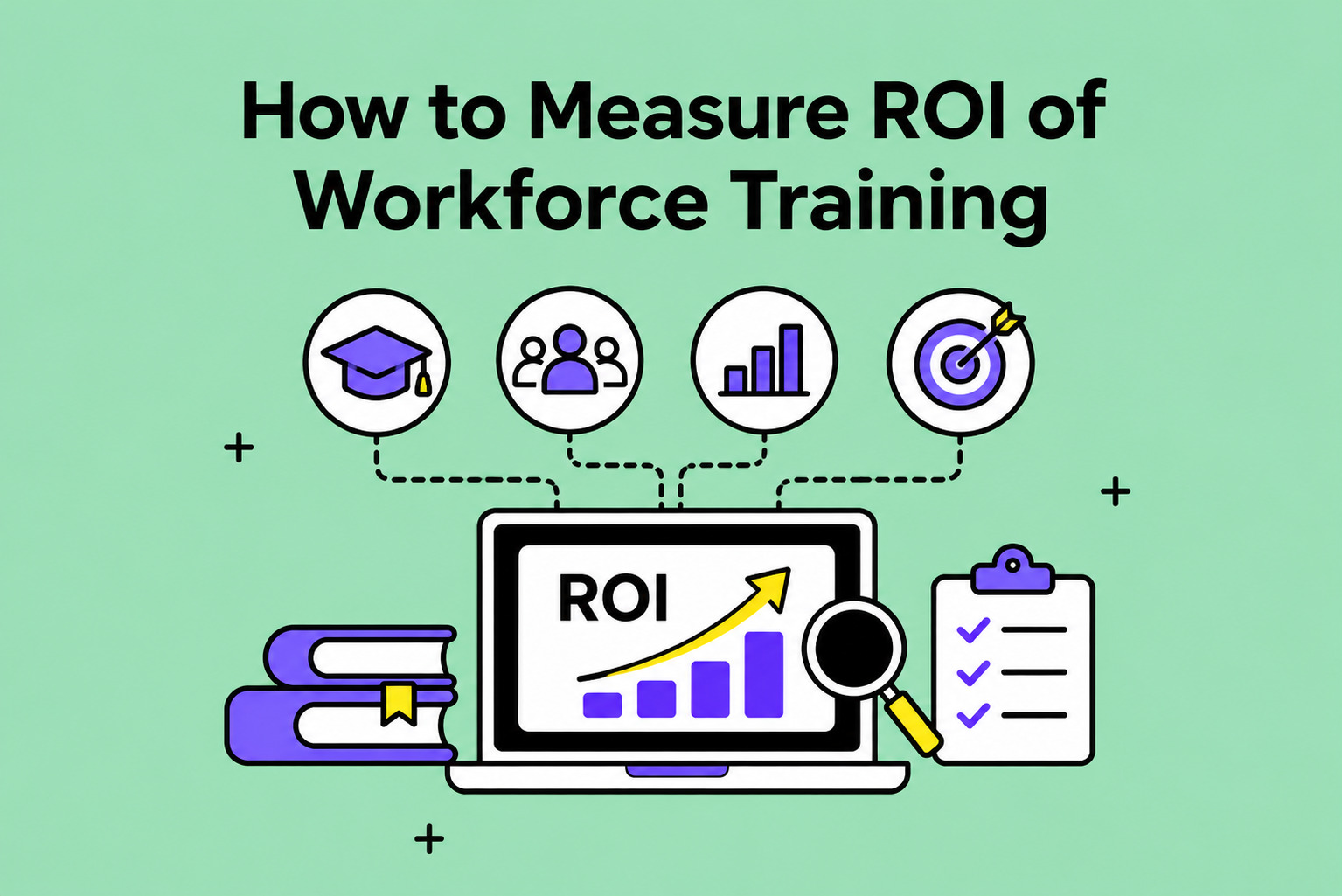
How to Measure ROI of Workforce Training
TL;DR: Sooner or later, finance wants to see the receipt for that training investment. And, no, not just how much money you spent. You’ll want to show what changed and how much those changes were worth.
Start with a snapshot of performance before training. Then tally the full bill, including the time employees spend learning. As people put their new skills to work, track improvements and translate them into dollars when you can. Connect your training investment into measurable results, and it gives finance teams something to work with.
Spending on employee training is easy, but measuring its ROI is difficult. The costs land in one budget and the results in another. However, those results can take time to appear. You might pay for a program in January and not see hiring or retention shifts until the summer.
That makes budget conversations tough. HR, L&D, and finance leaders all want proof, but they may define it differently.
A simple framework can help. Workforce training ROI is a financial return that a training program delivers against what it costs. In this article, we’ll walk through setting a baseline, counting costs, picking the right metrics, and running the math.
Table of Contents
- How Do You Measure the ROI of Workforce Training?
- Is Employee Reskilling Worth the Cost?
- Key Takeaways
How Do You Measure the ROI of Workforce Training?
Follow these four steps to measure the ROI of your workforce training:
- Set a baseline before any training starts.
- Calculate the full cost of the program.
- Track outcomes tied to the business problem you want to solve.
- Compare the financial benefits with the investment.
Let’s break down each step.
Set a Baseline Before Training Starts
You can only show improvement when you have a “before” picture. Start by naming and defining the business problem. It might be slow onboarding, unfilled roles, or a specific skills gap.
The next step is to record your starting numbers. Useful baseline measures include:
- Time to competency: How long it takes someone to work independently in a role.
- Retention: The share of employees who stay beyond a set period.
- Internal hiring rate: The share of open roles filled by current employees.
- External recruiting cost: How much you spend to fill the roles with external candidates.
Note down where each number comes from. Common sources include skills assessments, HR reports, recruiting records, and manager evaluations. Record the date and how you define each measure, too, so you can make consistent comparisons later.
Count the Full Cost of Training
Tuition or provider fees are only part of the bill. A credible ROI case counts everything:
- Provider or tuition fees.
- Employee learning time.
- Equipment and software.
- Learner support, such as coaching or tutoring.
- Internal administration and reporting.
- Instructor or manager time.
Employee learning time is easy to overlook. To estimate it, multiply each employee’s training hours by their hourly employment cost.
Training hours per employee x Hourly employment cost = Learning-time cost per employee
Use an hourly employment cost that includes wages, benefits, and payroll taxes. For example, 120 hours at $35 per hour is $4,200 per learner.
What Metrics Matter for Corporate Training Programs?
Focus on metrics tied to your original business problem. You don’t need to track everything. Pick a few and measure them well.
Here are five common metrics:
- Completion rate: The percentage of enrolled learners who finish. Divide the number who complete training by total enrollees and multiply by 100. Completion rate shows participation but not business results.
- Time to competency: The days or weeks someone takes to perform at the expected level. Compare it with your baseline using manager evaluations or skills assessments. It helps show how quickly employees reach the expected performance level.
- Retention: Before training, record the existing retention rate for the team or employee group you plan to train. Afterward, track the percentage of participants who stay with the company over a comparable period. You can also compare their retention rate with that of similar employees who didn’t participate.
- Internal mobility: The share of employees who shift to new roles inside your company. Calculate the percentage of participants who receive a promotion or make a lateral move within a set period. This can help show whether training supports your talent pipeline.
- Reduced hiring costs: Track changes in external recruiting spending as employees move into roles internally. Compare those costs with your baseline.
Not every metric is a financial return. Course completion and demonstrated skill gains are learning indicators. Time to competency and retention are business outcomes. Outcomes become financial benefits when you translate their value into dollars. Finishing any course doesn’t automatically create a return.
Calculate ROI and Build Your Budget
Use this formula:
ROI = (financial benefits – training costs) ÷ training costs x 100
Here’s a hypothetical example using made-up figures. A company plans to train 10 employees for data analyst roles instead of hiring externally. Let’s look at their total costs.
- Provider fees: 10 learners ✕ $4,000 = $40,000
- Learning time: 10 learners ✕ 120 hours ✕ $35 per hour, including benefits and payroll taxes = $42,000
- Software and equipment: $3,000
- Administration and manager time: $5,000
The total cost is $90,000. Next, compare that investment with the potential financial benefits. In this example, the company estimates that it would spend $15,000 to fill each role externally. Filling all 10 roles internally would avoid $150,000 in external hiring costs.
Subtracting the $90,000 training investment from the $150,000 benefit gives an estimated net benefit of $60,000. Using the formula above, ROI = $60,000 ÷ $90,000 × 100, or about 67%.
At the budget meeting, show your baseline, full costs, and estimated financial benefits. Clearly communicate what’s measured and what’s assumed. Show how the ROI changes if the benefits are lower than expected. This example assumes training enables all 10 internal hires. Any costs of filling the roles those employees leave behind would reduce the net benefit and ROI.
Is Employee Reskilling Worth the Cost?
Employee reskilling can be worth the cost when it addresses a real skills gap and delivers measurable benefits. Reskilling means preparing current employees for new or substantially changed roles.
The potential benefits include:
- Better retention: Employees can see opportunities to grow within your company.
- Faster adaptation: Your team develops skills to keep up with changing tools and business needs.
- Retained knowledge: Employees already understand your customers, systems, and culture.
- A stronger internal pipeline: You can prepare current employees to fill emerging roles.
Research offers some context for weighing those benefits. SHRM puts the average cost per nonexecutive hire at $5,475. Meanwhile, LinkedIn found that employees stay an average of 5.4 years at companies that excel at internal mobility, compared with 2.9 years at those that struggle with it.
Now compare reskilling with the realistic alternatives:
- External hiring: Account for recruiting costs and the time a new employee needs to get up to speed.
- Outsourcing: Consider project fees, ongoing costs, and whether your team will retain the knowledge.
- Leaving the gap unresolved: Estimate the cost of not training employees, including delayed projects, overtime, and potential turnover.
Corporate reskilling isn’t always the cheaper option. Compare the cost and time required for each approach against the skills you need and when you need them.
Key Takeaways
Building a workforce training ROI case comes down to a few specific habits. Set a baseline first so you can compare performance before and after training. Count the full cost, including learning time, support, and administration, not just fees.
Focus on metrics tied to the business problems you want to solve. Keep the learning indicators separate from financial benefits. Finally, keep your estimates conservative and explain which improvements you can reasonably attribute to training.
Program structure also matters. Skillcrush’s cohort model helps learners progress together. Wraparound support helps them stay on track, while program reporting gives leaders visibility into their progress. This type of setup makes ROI much easier to show.
To explore training options for your team, let’s talk about your team’s goals and how Skillcrush can help.