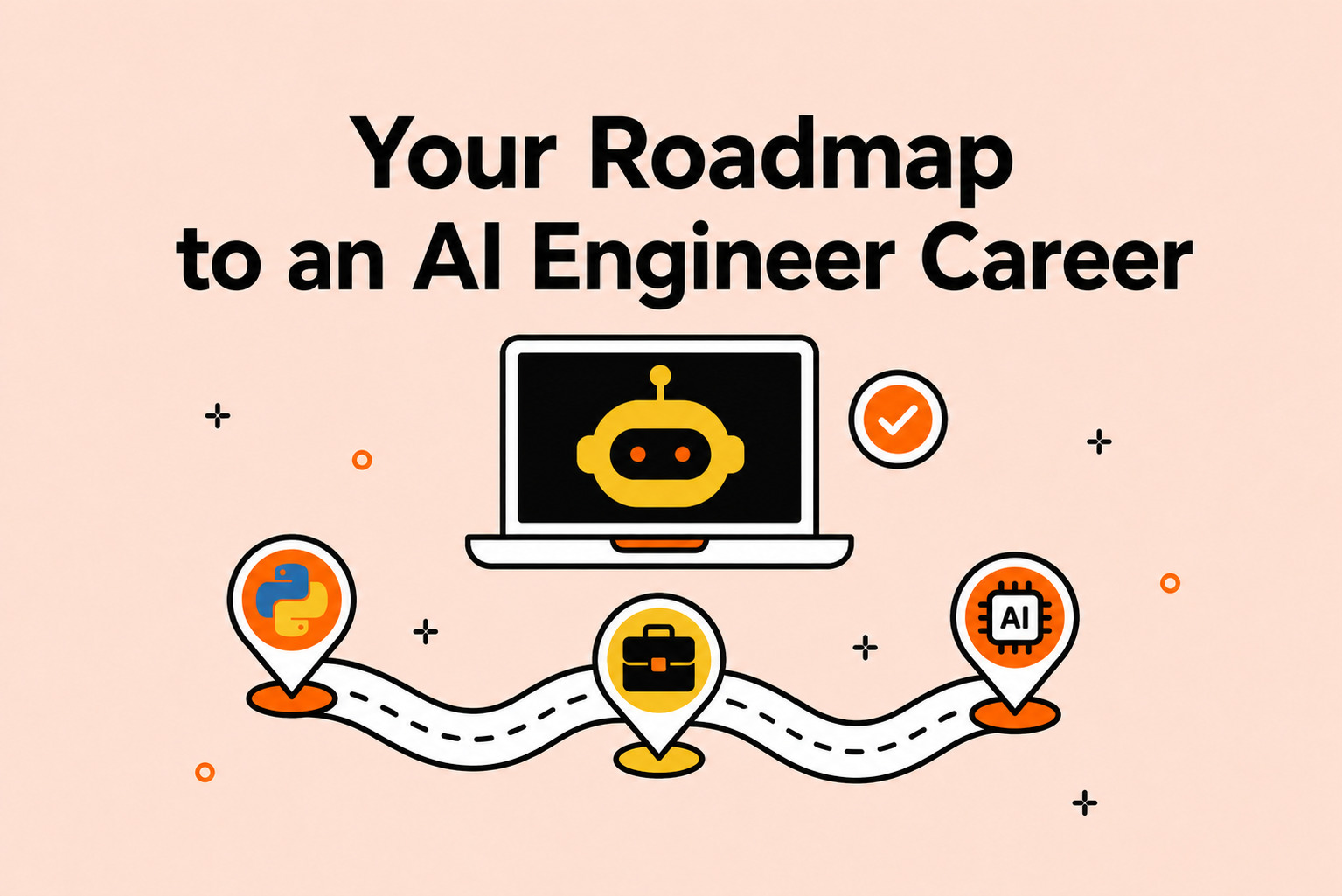
Your Roadmap to an AI Engineer Career
TL;DR: Becoming an AI engineer is a slow, step-by-step shift, not an overnight transformation. Start by learning the core skills. Your first tech job might not have “AI” in the title, but you’re building that path one skill, one project, and one role at a time—and that’s exactly how real AI careers are made.
You know that feeling when you read about AI engineers and think, “I would love that job, but I don’t have a tech degree”?
An AI engineer career path is still possible. After all, most people don’t land an AI engineering role as their first job. They often work their way up to that career.
This article walks you through the career path of an AI engineer, shows you how your current non-traditional background still counts, and helps you figure out where you are on the path.
Table of Contents
- What AI Engineers Do Day-to-Day
- Stage 1: Laying the Foundations
- Stage 2: Your First Tech Role
- Stage 3: Transitioning into AI-Focused Work
- Signs You’re Ready to Target AI Engineer Roles
- How Your Non-Technical Background Can Help
- Realistic Timelines and Milestones
- Next Steps If You Want Structured Support

Is Tech Right For you? Take Our 3-Minute Quiz!
You Will Learn:
☑️ If a career in tech is right for you
☑️ What tech careers fit your strengths
☑️ What skills you need to reach your goals

What AI Engineers Do Day-to-Day
AI engineers typically build, deploy, and maintain the AI systems that power tools like chatbots, recommendation engines, and automation features.
Instead of just building something once and walking away, they spend their time fine-tuning existing models, integrating large language models (LLMs) into products, or monitoring how AI systems perform.
There are other AI-adjacent roles as well, so it’s easy to confuse AI engineers with them. Here’s a quick distinction:
- Data scientists: They focus on analyzing data and building models to find insights and predictions.
- Prompt engineers: They specialize in crafting inputs that get the best results from AI models.
- Machine learning (ML) researchers: They focus on advancing algorithms and techniques, often in academic or research settings.
- AI engineers: They take existing AI models and research and turn them into working, real-world products.
AI engineering isn’t just about writing code. It also requires strong communication, domain knowledge, and collaboration skills, as you might often have to translate between technical and product teams. If you’re coming from a non-technical background, you likely already have some of these skills. And if that’s your case, it’s a real head start.
Stage 1: Laying The Foundations
You don’t have to quit your job to start this journey. You can begin with small, consistent steps while you’re still in your current role.
Focus on learning these fundamentals:
- Python: It’s a great first language to learn since it’s the most popular language in AI and ML.
- Data basics: Get familiar with how data is collected, cleaned, and structured.
- ML concepts: Start with the big ideas, such as what a model is, how training works, and what makes AI “learn.”
You don’t need to enroll in a fancy program to get started. You can learn these skills through structured online courses or by teaching yourself with free resources.
The key is to keep applying what you’re learning through small projects. Even a simple project, like building a chatbot or data cleaning script, can do wonders for your confidence and give you something real to show in your portfolio.
Stage 2: Your First Tech Role
Your first tech job probably won’t have “AI” in the title, and that’s okay.
Realistic entry points include roles like junior developer, data analyst, or automation engineer. These kinds of jobs help you get comfortable with real codebases, data pipelines, infrastructure, and cross-functional teams. All of which makes your eventual shift into AI-focused work feel more doable.
Even if AI isn’t in your job title, you can still look for ways to bring it into your day-to-day tasks. Look for chances to automate repetitive tasks with simple AI tools, or to play with an API in a low-stakes project. These small moves add up and become the experience you’ll point to later.
Stage 3: Transitioning into AI-Focused Work
Once you’ve bagged a tech role, stage three is about intentionally shifting your work toward AI. This is where you start moving from just using AI tools to actually designing, building, and integrating AI systems into real products and workflows.
At this stage, prioritize deepening skills like:
- Deploying models and AI features into production.
- Working directly with LLMs and AI APIs.
- Monitoring and improving AI system performance over time.
Job titles at this stage can vary quite a bit. You might see AI engineers, ML engineers, data engineers, or even AI product managers. Don’t get too attached to the exact titles. Pay attention to the responsibilities and how much time you’d spend working with AI.
Signs You’re Ready to Target AI Engineer Roles
Not sure if you’re ready to start applying? Look for these specific signs:
- You’ve built several Python projects, including at least one ML or LLM project from start to finish.
- You’re comfortable with not just writing from scratch but also reading and modifying code written by other people.
- You’ve created something other people can actually use.
- You can explain your projects clearly to people with a non-tech background.
- You have a portfolio or GitHub that shows off your AI work.
Is Tech Right For you? Take Our 3-Minute Quiz!
You Will Learn:
☑️ If a career in tech is right for you
☑️ What tech careers fit your strengths
☑️ What skills you need to reach your goals
How Your Non-Technical Background Can Help
Your background isn’t a gap to hide or something to feel weird about. It’s an asset to lean on. The experience you already have helps you design AI systems that solve real problems, instead of building shiny tools that miss what people actually need.
For example, someone with an operations background is well-suited to build AI automations or internal tools because they’ve lived those workflows themselves. A customer support background might bring a sharper eye for how an AI chatbot should handle real human conversations.
On top of domain knowledge, you’re also bringing transferable skills like communication, project management, or problem-solving. Highlight them clearly in your resume, LinkedIn summary, and cover letters.
If you want extra support deciding what to emphasize, make a list of must-have AI engineer skills. It can help you figure out what strengths to spotlight and which ones you can build over time.
Realistic Timelines and Milestones
Paths can look pretty different depending on where you start and how much time you can realistically dedicate. But here’s a general guide:
- Six to 12 months on foundational skills, while continuing your current job.
- One to two years in your first tech role, building real experience.
- One to two years deepening AI-specific skills and making the transition.
That adds up to a few years, not a few months, and that’s normal. This is more of a marathon than a sprint.
Instead of counting months, focus on milestones you can control, like:
- The number of projects you’ve shipped.
- How comfortable you feel working with production code.
- How clearly you can explain an AI solution to someone else.
- How much your professional network has grown.
Milestones give you something concrete to celebrate on the days when the timeline feels slow. The goal is steady progress.
Next Steps If You Want Structured Support
Becoming an AI engineer without a traditional tech background takes real effort, but it’s completely in your grasp. In order to build a path that’s realistic and sustainable, you first need to focus on the fundamentals. Later, get real experience in an entry-level tech job, and gradually shift your focus towards building AI-specific skills.
If you’d like a more detailed roadmap, check out Skillcrush’s Gen AI engineering career path to get expert support. A guided program like this can help you move through each of these stages with more confidence.
Is Tech Right For you? Take Our 3-Minute Quiz!
You Will Learn:
☑️ If a career in tech is right for you
☑️ What tech careers fit your strengths
☑️ What skills you need to reach your goals