Agentic AI vs Generative AI for Beginners
TL;DR: Generative AI is your creative friend that likes to write and make images. Agentic AI is your type-A friend that plans, decides, and gets things done. Both are huge for everyone in tech right now. Learning the basics of each puts you ahead.
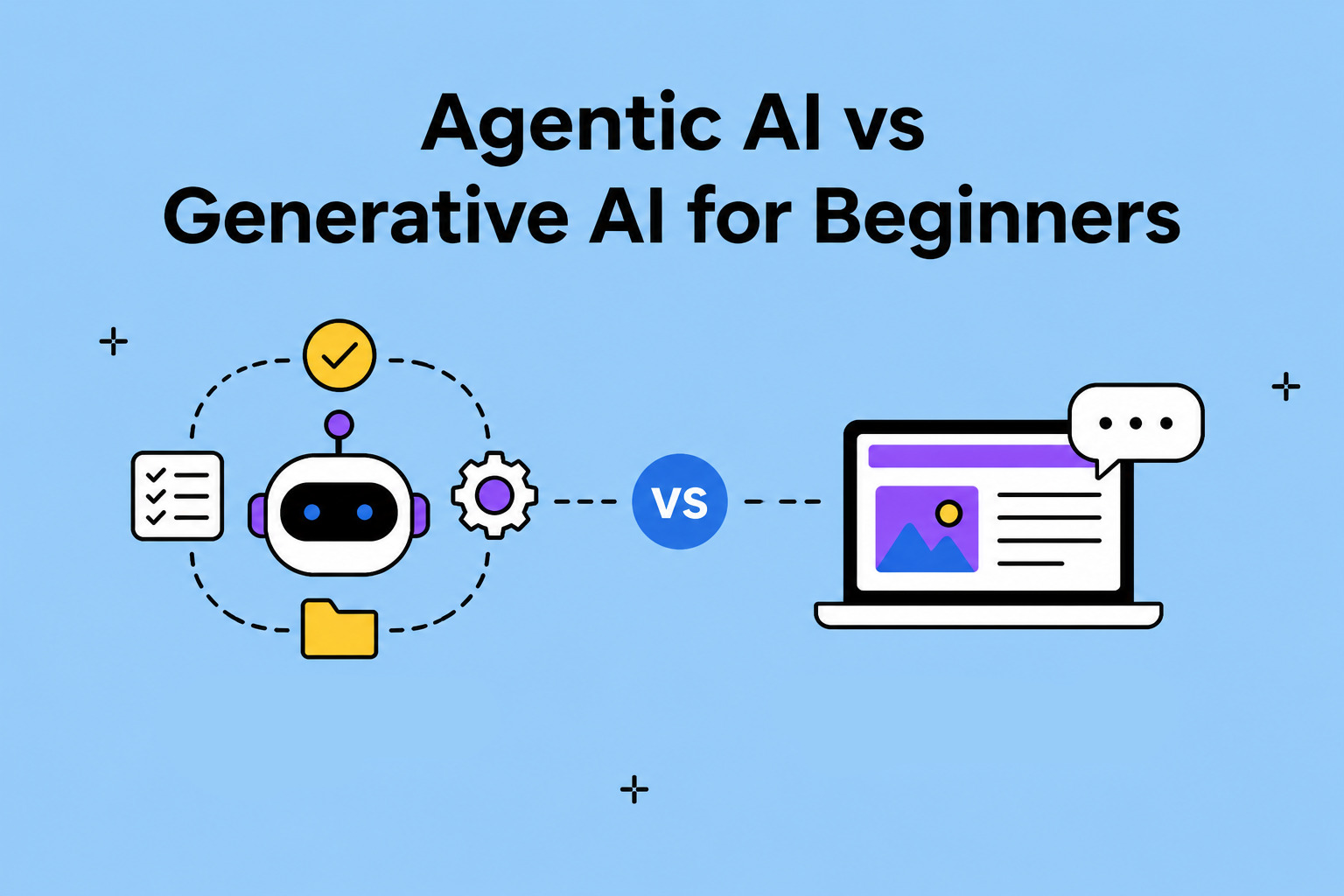
Not all AI works the same way. Generative AI creates things and is guided by humans. On the other hand, agentic AI takes action and can work on its own.
Understanding the difference matters for anyone working in tech. Let’s break down what each one actually does, how they’re different, and why it matters for you.
Table of Contents
- What You Need to Know About Agentic AI vs Generative AI
- Generative AI Explained
- Agentic AI Explained
- Key Differences of Agentic vs Generative AI
- How Generative AI and Agentic AI Work Together
- How to Learn Generative AI and Agentic AI
- Key Takeaways
- FAQs

Is Tech Right For you? Take Our 3-Minute Quiz!
You Will Learn:
☑️ If a career in tech is right for you
☑️ What tech careers fit your strengths
☑️ What skills you need to reach your goals

What You Need to Know About Agentic AI vs Generative AI
Both of these types of AI are now reshaping how developers work. Understanding the difference between the two helps figure out what to learn and build.
Before we dig in, here’s a quick overview of each.
Generative AI
Generative AI creates things. You give it a prompt as input, and it gives you the desired content as output.
The output could be anything: a paragraph, an image, a block of code, a summary, or even a video. Think of it as a knowledgeable assistant. Give it a task and clear instructions, and it gets it done.
Agentic AI
Agentic AI does tasks on your behalf. Unlike generative AI, it doesn’t just respond to one single prompt. Agentic AI manages a complete workflow. It takes goals, breaks them into steps, and works through those steps, often with little to no human input.
Generative AI Explained
Generative AI is the core technology behind tools like ChatGPT, Google Gemini, DALL-E, and GitHub Copilot.
Here’s how it works:
Generative AI models are trained on a massive amount of data, including text, images, code, and more.
That training teaches pattern recognition as well as what a useful and coherent output looks like. When you type a prompt, you get new content based on what you asked for.
Real examples of generative AI include:
- ChatGPT answers questions, drafts emails, explains concepts, and helps with brainstorming.
- DALL-E and Midjourney generate images.
- GitHub Copilot suggests and auto-completes code as you type.
- Claude helps with writing, analysis, coding, building workflows, and more.
What you can build with generative AI:
- A chatbot that responds to customers’ questions.
- A summarizing tool for long documents.
- An app that generates social media captions.
- A coding assistant.
Generative AI is powerful. However, it responds to you. It’s not capable of doing things on its own. That’s where agentic AI comes in.
Agentic AI Explained
An agent is someone who acts on behalf of someone else. That’s exactly what agentic AI does.
Here’s how it works:
- You give it an objective.
- It figures out the steps needed to get there.
- It executes those steps.
- Checks its own progress.
- Fixes itself when something doesn’t work.
At its core, agentic AI uses an LLM (large language model) as its reasoning engine. But it also has the ability to use tools.
Agentic AI searches the web, runs code, sends emails, and interacts with other apps. These actions are done in a loop until the task is done.
Real-world examples of agentic AI:
- OpenAI’s operator agent browses the web and completes tasks like booking reservations or filling forms.
- Auto-GPT and BabyAGI can break a goal into sub-tasks and work through them.
- Devin writes code, runs tests, and fixes bugs in one sequence.
What you can build with agentic AI:
- An AI assistant that monitors your inbox and drafts replies for routine emails.
- A research tool that can search the web, compile information, and make a report out of it.
- A coding agent that can review pull requests and suggest fixes.
- A bot for e-commerce that checks inventory, processes orders, and updates customers.
Agentic AI is more complex to build than generative AI. However, it’s also one of the fastest-growing areas.
Key Differences of Agentic vs Generative AI
| Generative AI | Agentic AI | |
| What it does | Generates content in response to prompts | Takes small actions to complete a goal |
| How it responds | One response based on a prompt | Multi-step response, loops back to check progress |
| Human involvement | High | Low |
| What it produces | Text, images, code, audio | Actions, workflows, completed tasks |
| Complexity level | Beginner-friendly | More advanced; requires systems thinking |
| Common use cases | Writing, summarizing, coding assistance | Automation, research agents, task execution |
| Learning curve | Low | High |
Is Tech Right For you? Take Our 3-Minute Quiz!
You Will Learn:
☑️ If a career in tech is right for you
☑️ What tech careers fit your strengths
☑️ What skills you need to reach your goals
Which One is More Valuable to the Job Market Right Now?
Both are valuable in their own ways. Generative AI skills are essential in a lot of tech and marketing roles. Meanwhile, agentic AI skills are newer to the market, but they are in high demand.
Developers who know how to build with agents have a real edge. If you can, learn how to use both. It’ll put you in a strong position in the job market.
How Generative AI and Agentic AI Work Together
Agentic AI and generative AI are almost always used together. Here’s how that looks in practice.
Example 1: Customer support
Imagine that you’re building a smart customer support assistant. Generative AI drafts messages that sound natural and branded. Agentic AI pulls the right account information, checks order status, and sends a message when it’s ready. Neither one can do its job alone.
Example 2: Research
You’re building an AI-powered research tool. The agentic system handles the workflow. It decides what to search for, calls a web search tool, reads the results, and decides whether to dig deeper. Generative AI writes the final summary in clear and readable language.
As a developer, you’ll use some combination of both. The generative model acts as the brain, and the agentic layer as its hands.
How to Learn Generative AI and Agentic AI
Start with Generative AI
Get comfortable with how LLMs work. Learn how to write prompts and connect AI tools using APIs. This builds your foundational AI skills.
Layer in Agentic AI
Once you understand how generative AI works, you can start learning how to build systems. Focus on connecting steps, adding tools, and giving the AI a structure. Frameworks like LangChain and LangGraph can help you build agentic AI systems.
Build Projects for Your Portfolio
The best way to learn is to create. Start with a simple AI tool like a script that summarizes your emails or a chatbot that answers questions. Adding these projects to your portfolio can demonstrate that you understand AI tools.
Key Takeaways
Generative and agentic AI are distinct but complementary technologies. Generative AI generates text, images, videos, and code when you prompt it. Agentic AI takes it a step further by completing multi-step tasks and acting autonomously.
As a developer, learning both is worth your time. If you’re looking for support to build AI projects, join Skillcrush’s AI Developer track. It offers real projects, a supportive community, and instructions designed specifically for beginners.
FAQs
Do I Need to Know Python to Work With AI?
For advanced AI work, you do need to know Python. It’s also the most common language in AI development. However, you don’t need to know Python as a beginner. Many AI tools are accessible with low-code or no-code interfaces or simple API calls.
Is Generative AI or Agentic AI Harder to Learn?
Generative AI is easier to learn. You need to know how to write efficient prompts to create good outputs. Agentic AI involves more dynamic parts. You need to learn how to connect tools and handle workflow problems.
Which AI Type is Better for My First Project?
Start with generative AI. Pick a simple problem like summarizing a doc or answering questions from a file. And try building a small app around it. Once that works, you’ll have a foundation to start experimenting with agentic workflows.
Is Tech Right For you? Take Our 3-Minute Quiz!
You Will Learn:
☑️ If a career in tech is right for you
☑️ What tech careers fit your strengths
☑️ What skills you need to reach your goals

Shreyasi Bhattacharya
Category: Artificial Intelligence, Artificial Intelligence Jobs, Blog