What is Object-Oriented Programming (OOP)?: A Beginner’s Guide
TL;DR: Object-oriented programming (OOP) is all about organizing code so you can reuse it later. It bundles data and actions into objects. It’s almost like a LEGO block. You can use a LEGO block for one project, and then use it again for a different model. OOP acts the same way. By creating reusable classes and objects, apps are easier to grow and maintain.
Object-oriented programming (OOP) is a way to organize code and make it easier to reuse for other projects.
The object basically consists of two integral parts: data (what something is) and behavior (what it can do). OOP prevents rewriting instructions again and again. Instead, you can put related data and actions into an object.
Think of it as labeling the bottle of spices in your kitchen. The label tells you what’s inside (that’s the data).
The jar serves as a reminder of the behavior – whether that’s sprinkling, reusing, or tossing it when it’s empty. Without the data and behavior, you would have random spices everywhere with no clear purpose. OOP lets you organize everything and make it easier to reuse.
This article will break down OOP’s structure and components. It’ll also share real-world examples and best practices to boost your confidence by the end of this read.
Table of Contents
- What Are Object-Oriented Programming Languages?
- What Is the Structure of OOP?
- What Are the Four Pillars of OOP?
- Why Use OOP?
- What Is an Example of an OOP Process?
- Best Practices for OOP?
- Key Takeaways
- FAQs

Is Tech Right For you? Take Our 3-Minute Quiz!
You Will Learn:
☑️ If a career in tech is right for you
☑️ What tech careers fit your strengths
☑️ What skills you need to reach your goals

What Are Object-Oriented Programming Languages?
OOP is a free bird; no single language ties it down. OOP is a programming paradigm supported by several popular languages, like:
- Python
- Java
- C++
- Ruby
- C#
- Swift
OOP is part of everything from mobile apps and web platforms to data tools and games. Novices may want to start learning Python first. Unlike Java, which forces OOP from the beginning, Python lets you experiment at your own pace.
What Is the Structure of OOP?
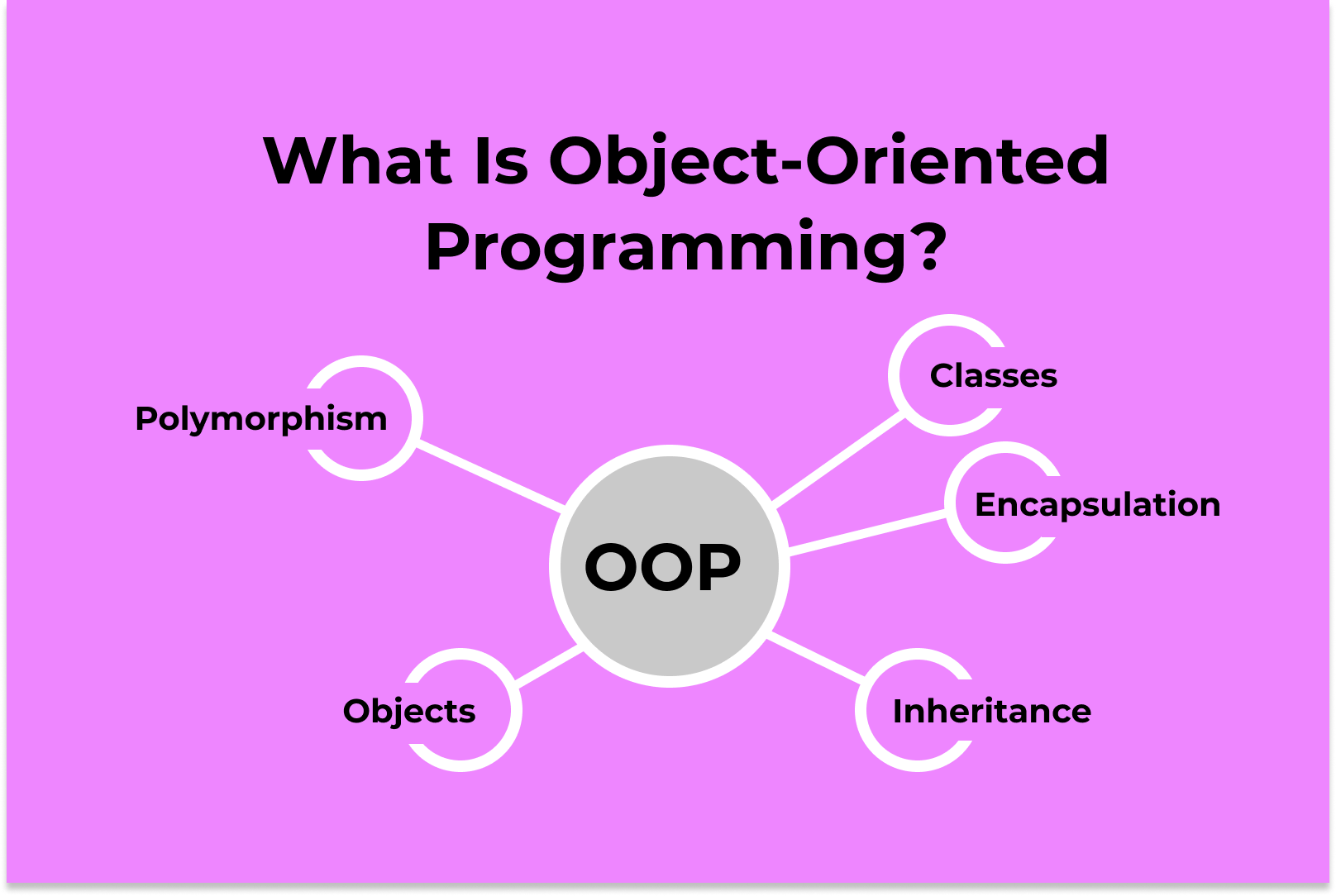
The structure of OOP has four foundational building blocks: classes, objects, methods, and attributes. A solid structure helps you write efficient and reusable code.
Classes
Classes like a blueprint or template for objects. A class defines what an object looks like and what it can do, but it isn’t the object itself.
Imagine a class being a cookie-cutter. It tells you the shape of the cookie. You can stamp out as many cookies as you want out of it, but it isn’t the cookie itself.
Objects
An object is created using the class. Each cookie cutter stamps out a cookie, which is the object. You can make as many objects as you want from one single class. And all objects don’t need the same aspects.
Attributes
Attributes are the object’s data or properties. Going back to the cookies, a cookie is an object, and its flavor, frosting, and shape are all its attributes.
Methods
Methods are the object’s actions. Consider if a class were dogs. Methods for the dog will include sit(), bark(), or fetch().
Methods define behavior. Don’t confuse it with attributes; they define characteristics.
What Are the Four Pillars of OOP?
Besides the four building blocks, there are four pillars of object-oriented programming.
Encapsulation
Picture a TV remote control. You press buttons to change channels without knowing the internal circuitry. Encapsulation works the same way.
Encapsulation translates to building an object’s data and methods together. Meanwhile, it also hides internal details from the outside world. You only let people see what’s necessary.
Inheritance
Inheritance helps one class inherit properties from another class. A child class has all the properties of the base class, in addition to its own.
For example, a class GoldenRetriever() has all the properties of the class Dog(). Additionally, it can add more properties like fetch() and age(). With inheritance, the developer won’t have to rewrite the same code again and again.
Polymorphism
Polymorphism means many forms. In OOP, it allows the same functions to have different behaviors.
Let’s say a developer puts the function speak() on a Dog object, it will bark. If you add the same speak() function to a cat object, it meows. The feature makes it flexible and extendable.
Abstraction
Abstraction hides complexities and only shows what’s essential. It simplifies outside appearances, so people don’t get overwhelmed by looking at the complexities.
When you drive a car, you only think about turning the steering wheel and using the pedals under your feet. You don’t worry about how the engine works. You just focus on driving. Abstraction lets you interact with objects at a high level without exposing their internal workings.
Why Use OOP?
Here’s why developers prefer using OOP:
- Reusable code: Write a class once and use it as many times as you want.
- Easier to maintain: If something breaks, you don’t need to hunt through hundreds of lines of code. You only need to fix it in one place.
- Supports collaboration: Teams can work on separate classes or modules without invading each other’s work.
- Scalable projects: Add new features without having to rewrite the code every time.
- Ideal for agile development: Fits with iterative and fast-moving development workflows.
- Easier debugging: Because the code is well organized, it’s easier to isolate and fix bugs.
Is Tech Right For you? Take Our 3-Minute Quiz!
You Will Learn:
☑️ If a career in tech is right for you
☑️ What tech careers fit your strengths
☑️ What skills you need to reach your goals
What Is an Example of an OOP Process?
An animal shelter requires you to build an app. Without OOP, you might have to write the same long code for each animal in the shelter. The process is time-consuming and messy.
However, if you use OOP, then your process would look like:
- Create a Dog class as a blueprint.
- Class has attributes like name, breed, and age.
- Has methods like bark() and fetch().
- Every dog in the shelter becomes an object.
- Each dog has its own name and age, but shares the same behaviors.
In the same way, you can create classes for all the animals in the shelter.
Best Practices for OOP
Once you’re comfortable with OOP concepts, the SOLID principle enters the picture. The principle ensures clean and maintainable code.
- Single responsibility principle: Each class should do a single thing perfectly. A class shouldn’t manage your app’s database.
- Open-closed principle: Every class can have new features, but you don’t have to change the whole code.
- Liskov substitution principle: Even after replacing a base class object with a child class object, your program should still work the same.
- Interface segregation principle: Don’t force any class to include unnecessary methods. Keep the interface specific and focused.
- Dependency inversion principle: High-level code shouldn’t depend on low-level details. Instead, both should depend on abstractions.
Key Takeaways
Many programming languages use OOP, so understanding its pillars is crucial to getting a job in tech.
If you want to learn object-oriented programming, Python is a beginner-friendly language. By learning OOP and Python for Web Apps and Data, you can upgrade yourself from a complete beginner to a professional.
You’ve got this!
Is Tech Right For you? Take Our 3-Minute Quiz!
You Will Learn:
☑️ If a career in tech is right for you
☑️ What tech careers fit your strengths
☑️ What skills you need to reach your goals
FAQs
What Are the Four OOP Basics?
The four object-oriented programming principles are encapsulation (hiding details), inheritance (derived classes adapting from base classes), polymorphism (same function, different behavior), and abstraction (simplifying complexity).
Is Python an OOP Language?
Yes, Python is an object-oriented language. It supports all the components of OOP, like classes, objects, attributes, and methods. What makes it different from other OOP languages is that Python doesn’t force OOP.

Shreyasi Bhattacharya
Category: Blog, Coding Languages and Tools, For Beginners, JavaScript, Learn to Code, Python